Trending

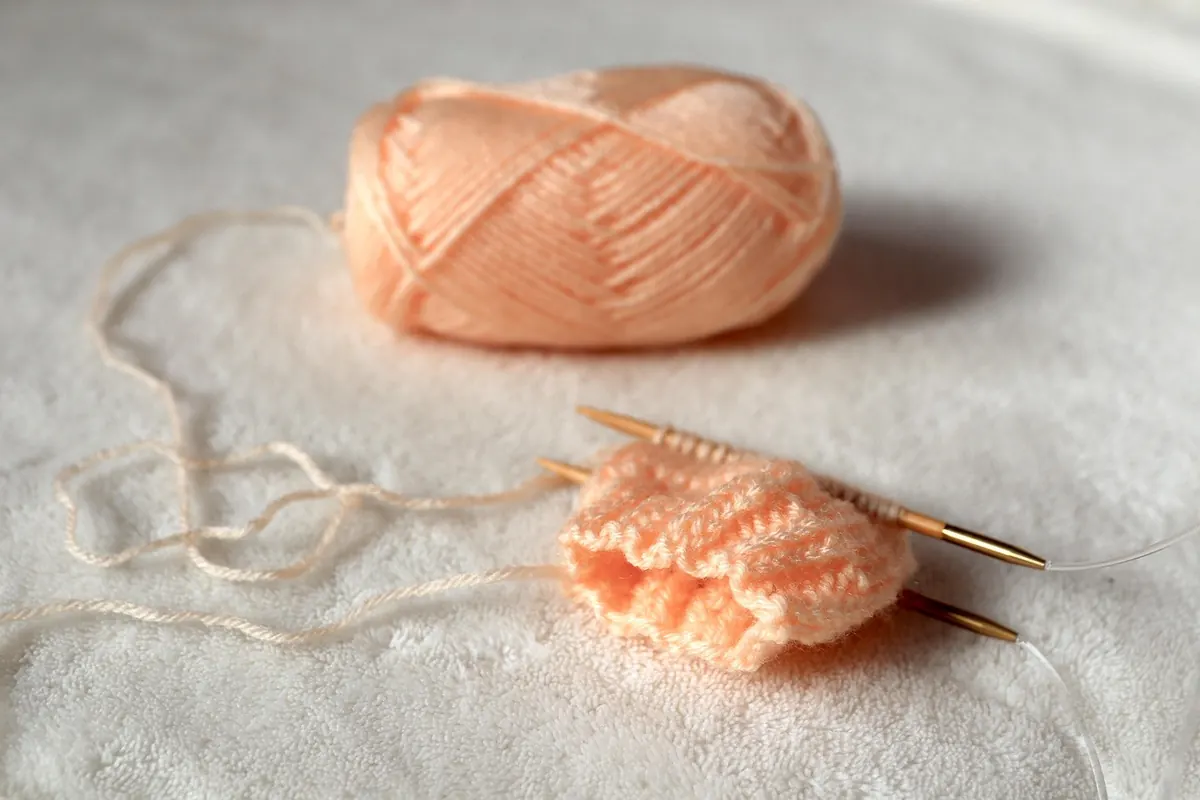
Ask three knitters which needles to buy and you will get three different answers. The useful truth is that straight and circular needles produce identical fabric. The difference lies in how they feel in your hands, how many stitches they can comfortably hold, and how much seaming you are signing up for at the end. Once you know what each type is genuinely good at, choosing stops being a matter of habit.
Straight needles are lovely for small, flat pieces: scarves, dishcloths, swatches, baby cardigan backs, anything you can rest in your lap. Circular needles take over as soon as your stitch count grows, your project gets heavy, or you want the work joined in a loop. Many knitters eventually keep a couple of straight pairs for old times' sake and do almost everything else on circulars.
There is no rule that says flat knitting must happen on straight needles, and no rule that circular needles are only for hats. Both crossover points are worth knowing.
Straight needles are the pair most people learn on, and that familiarity counts. You can see every stitch clearly, there is no cable to manage, and the right needle can be tucked under your arm or braced against your lap, which some knitters find faster and less tiring for plain stocking stitch. They are inexpensive, easy to put down mid-row, and easy to hand to a friend who wants to try a few stitches.
The limitation is capacity. Once you push past roughly 100 to 150 stitches, depending on the needle length and yarn weight, the weight of the fabric starts pulling on your wrists and the stitches crowd together. A wide blanket on straight needles is a workout. Straight needles also mean seams if you are making a garment, and two long rigid sticks are awkward on a busy train.
A circular needle is two short tips joined by a flexible cable. Used as intended, it lets you knit round and round without seams, and because the cable rests in your lap, the weight of the work never hangs from your hands. A jumper body at 100cm circumference is comfortable on an 80cm circular. The same jumper on two straight needles would be miserable.
Circular needles also handle small circumferences once you learn one of the techniques: magic loop on a long cable, the travelling loop method, two circulars at once, or short interchangeable tips. For socks, a 23cm circular or a set of double-pointed needles will do the job, and both are worth trying before you decide which you prefer.
The trade-offs are real. There is a join to get used to, cords can hold a curve from the packaging until they warm up, and cheap fixed circulars often have a ridge where the cable meets the tip that catches your yarn. Cable length has to suit both your stitch count and the way you are working, which trips up more knitters than any other detail.
For knitting in the round, choose a total needle length slightly shorter than the circumference of the piece. The stitches should spread around the cable without being stretched tight. A 40cm circular suits a hat; an 80cm circular suits a jumper body. For a small circumference on a long cable, that is exactly when magic loop becomes useful.
Too long a cable with too few stitches is the classic cause of ladders and pulled-out stitches, unless you are deliberately using one of the small-circumference methods. Extra fabric can be pushed onto the cable to try a garment on, but bunched stitches are not a good way to knit an entire row.
Cast on, knit to the end, turn the work, purl back. That is flat knitting, and it works perfectly on a circular needle. You simply treat the pair as one long needle and let the cable dangle. It looks odd for the first few rows and then feels completely normal.
The advantages add up: no seam at the end unless you want one, the weight stays in your lap, wide panels become manageable, and needles cannot go missing separately. The one thing to watch is that many knitters work at a slightly different tension on circulars than on straights, so a gauge swatch matters more than ever. Swatch on the exact needle type you plan to use for the project.
If you are starting out, buy one good pair of circular needles in the size you use most, plus a set of straight needles in a mid-range size for swatches, and see which one you reach for. If you enjoy knitting in the round, an interchangeable set with a few cable lengths works out cheaper than buying fixed pairs one at a time, and it lets you change tip size mid-project when your tension shifts.
Keep a note of the needle size and type you used for every finished project, along with your gauge. That record will save you far more time than any needle recommendation you read online, because your hands are the only true test.
Finally, pay attention to comfort. Long knitting sessions on any needle can tire your hands, wrists and shoulders, so take regular breaks, vary your grip and check your posture. If pain persists or gets worse rather than easing, speak to a physiotherapist, hand therapist or your GP rather than knitting through it.
Photo: Sato-Imo / Pixabay